FlashPlays Live

Designing real-time engagement for live sports

Role

Scope

TEAMS

Founding Product Designer Lead

0→1

Product, Engineering

TL;DR

During live games, fans often tuned out during downtime.Collaborating with the Founders of FlashPlays Live, I designed a live prediction app that turned those dead moments into exciting, social experiences — helping fans stay connected and competitive throughout the game.

flashplays

Company Overview

FlashPlays is the only fan engagement tool made by fans for teams. Initially created by four college students as a fun game to play while watching sports, FlashPlays became a real-time prediction game in the US with over 6,000 users per contest. FlashPlays was offered to sports teams as a premier way to activate their fans during games and facilitate a loyalty journey throughout the season. 

The Challenge

While fans loved the energy of live sports, large parts of the viewing experience remained passive.This was an opportunity to deepen engagement and create a new ritual during downtime moments.

“There’s so much dead time during games — I zone out and scroll on my phone.”

Goal

Elevate the viewing experience by designing a companion experience that amplified excitement with real-time participation, rather than competed with, the live broadcast.

Framing the Opportunity

  • Conducted live-watch studies to map emotional peaks and valleys.
  • Reframed the problem from filling dead time → to sustaining fan rhythm.
  • Partnered with PM and engineering early to align on technical constraints: short windows, data sync, latency limits.

My Role

🎨 Sole Product Designer

Designed and validated the end-to-end fan experience from concept to launch.

  • Hosted live “watch party” research sessions to observe fan behavior and quickly identify friction points.
  • Defined the visual and interaction language to keep the experience exciting yet clear during live broadcasts.

🎯 PM Soundboard

Helped shape product direction by turning fuzzy ideas into clear, measurable hypotheses.

  • Translated fan insights into prioritized MVP experiments that guided roadmap decisions.
  • Collaborated with founders to define success metrics (session length, repeat play, social sharing)

🤝 Partner to Engineering

Bridged design and technical execution to bring real-time UX to life.

  • Designed and coded the UI in React Native for production-level fidelity and fast iteration between broadcasts.
  • Partnered with engineers during live NFL games to debug latency and fine-tune interaction timing in real conditions.

Key Decisions & Trade-offs

1. Game format: speed vs. depth

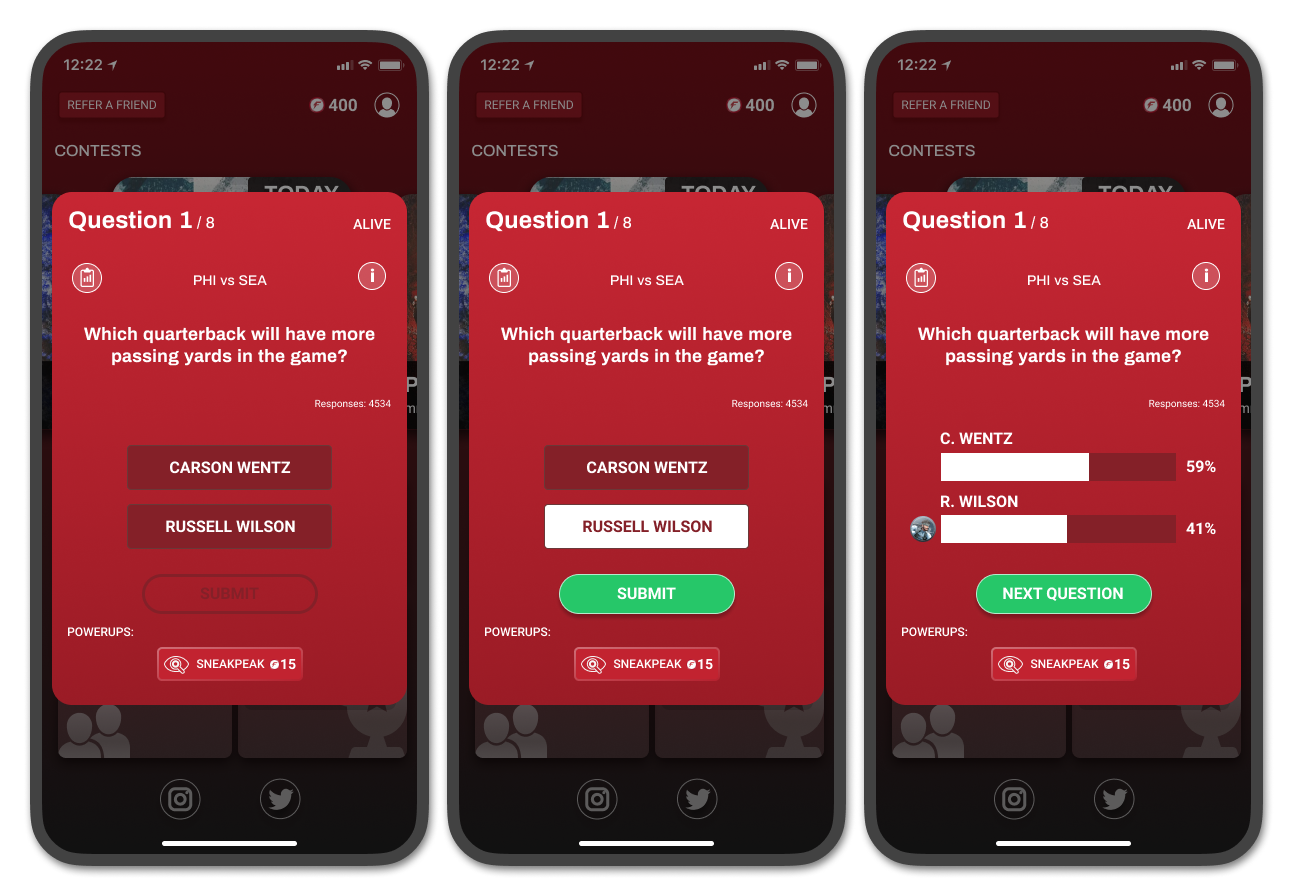
We debated between trivia-style questions (deeper knowledge, slower engagement) and predictive quick plays (fast, accessible).
fpl-QA

Decision:

Chose short predictive questions to sync with game pace — easier to play between snaps, scalable for any sport.

Trade-off

Less depth per session, but dramatically higher replayability and inclusivity for casual fans.

2. Interaction timing: energy vs. clarity

Early tests showed fans got anxious when predictions overlapped with live plays.

“The play isn’t done yet and the question goes live while I’m watching”

Decision:

Delayed question prompts by a few seconds post-whistle to reduce cognitive overload.

Trade-off

Slight delay in “real-time feel,” but improved trust and usability — fans felt the app understood the flow of the game.

3. Visual design: excitement vs. signal clarity

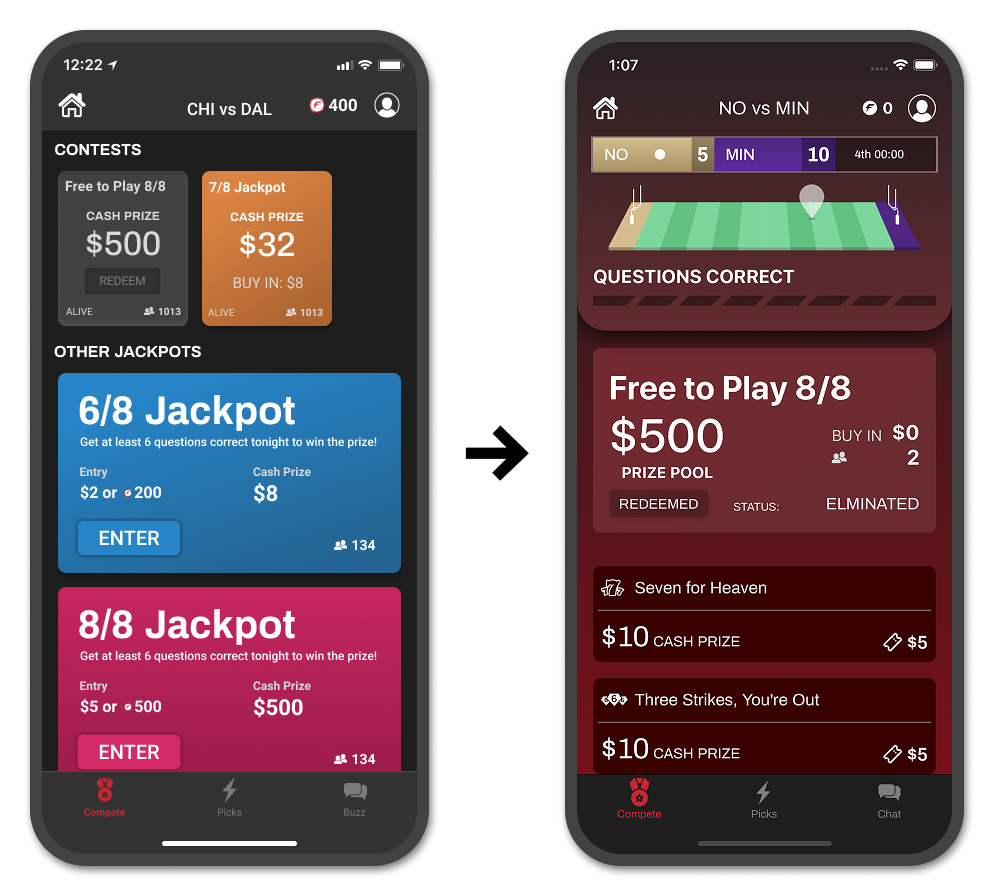
Our first UI leaned heavily into gamified visuals. In live tests, high color contrast and motion distracted during key plays.
fpl-before-after

Decision:

Simplified visual hierarchy — bold typography for key stats, muted palette to let broadcast remain primary.

Trade-off

Less “flashy” aesthetic, but vastly improved real-time readability and performance consistency.

4. Technical fidelity: experimentation vs. scalability

React Native offered design parity but limited native animation control.

Decision:

Chose RN for speed and cross-platform fidelity; worked with engineering to optimize micro-animations manually.

Trade-off

Sacrificed some advanced transitions, but allowed for real-time field testing and iteration between live games.

The Outcome

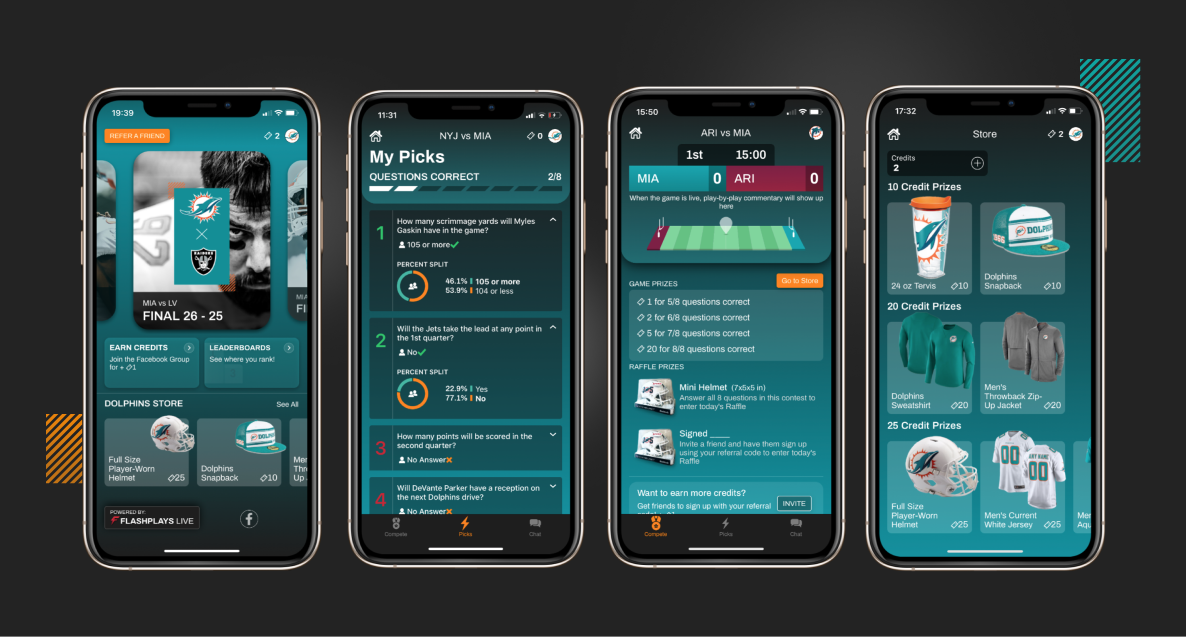
⚡ Increased average session length by 40% and boosted repeat play through interaction design that matched game tempo. 🏆 Featured in the App Store, powering “GameTime,” the branded version for NFL partners like the Miami Dolphins. 🔥 Built a loyal fan base that validated our core thesis — fans want to participate with the game, not just watch it.
gametime-app

Let's connect — I'd love to hear about your team.

in

@

FlashPlays Live

Designing real-time engagement for live sports

Role

Scope

TEAMS

Founding Product Designer Lead

0→1

Product, Engineering

TL;DR

During live games, fans often tuned out during downtime.Collaborating with the Founders of FlashPlays Live, I designed a live prediction app that turned those dead moments into exciting, social experiences — helping fans stay connected and competitive throughout the game.

flashplays

Company Overview

FlashPlays is the only fan engagement tool made by fans for teams. Initially created by four college students as a fun game to play while watching sports, FlashPlays became a real-time prediction game in the US with over 6,000 users per contest. FlashPlays was offered to sports teams as a premier way to activate their fans during games and facilitate a loyalty journey throughout the season. 

The Challenge

While fans loved the energy of live sports, large parts of the viewing experience remained passive.This was an opportunity to deepen engagement and create a new ritual during downtime moments.

“There’s so much dead time during games — I zone out and scroll on my phone.”

Goal

Elevate the viewing experience by designing a companion experience that amplified excitement with real-time participation, rather than competed with, the live broadcast.

Framing the Opportunity

  • Conducted live-watch studies to map emotional peaks and valleys.
  • Reframed the problem from filling dead time → to sustaining fan rhythm.
  • Partnered with PM and engineering early to align on technical constraints: short windows, data sync, latency limits.

My Role

🎨 Sole Product Designer

Designed and validated the end-to-end fan experience from concept to launch.

  • Hosted live “watch party” research sessions to observe fan behavior and quickly identify friction points.
  • Defined the visual and interaction language to keep the experience exciting yet clear during live broadcasts.

🎯 PM Soundboard

Helped shape product direction by turning fuzzy ideas into clear, measurable hypotheses.

  • Translated fan insights into prioritized MVP experiments that guided roadmap decisions.
  • Collaborated with founders to define success metrics (session length, repeat play, social sharing)

🤝 Partner to Engineering

Bridged design and technical execution to bring real-time UX to life.

  • Designed and coded the UI in React Native for production-level fidelity and fast iteration between broadcasts.
  • Partnered with engineers during live NFL games to debug latency and fine-tune interaction timing in real conditions.

Key Decisions & Trade-offs

1. Game format: speed vs. depth

We debated between trivia-style questions (deeper knowledge, slower engagement) and predictive quick plays (fast, accessible).

fpl-QA

Decision:

Chose short predictive questions to sync with game pace — easier to play between snaps, scalable for any sport.

Trade-off

Less depth per session, but dramatically higher replayability and inclusivity for casual fans.

2. Interaction timing: energy vs. clarity

Early tests showed fans got anxious when predictions overlapped with live plays.

“The play isn’t done yet and the question goes live while I’m watching”

Decision:

Delayed question prompts by a few seconds post-whistle to reduce cognitive overload.

Trade-off

Slight delay in “real-time feel,” but improved trust and usability — fans felt the app understood the flow of the game.

3. Visual design: excitement vs. signal clarity

Our first UI leaned heavily into gamified visuals. In live tests, high color contrast and motion distracted during key plays.

fpl-before-after

Decision:

Simplified visual hierarchy — bold typography for key stats, muted palette to let broadcast remain primary.

Trade-off

Less “flashy” aesthetic, but vastly improved real-time readability and performance consistency.

4. Technical fidelity: experimentation vs. scalability

React Native offered design parity but limited native animation control.

Decision:

Chose RN for speed and cross-platform fidelity; worked with engineering to optimize micro-animations manually.

Trade-off

Sacrificed some advanced transitions, but allowed for real-time field testing and iteration between live games.

The Outcome

⚡ Increased average session length by 40% and boosted repeat play through interaction design that matched game tempo. 🏆 Featured in the App Store, powering “GameTime,” the branded version for NFL partners like the Miami Dolphins. 🔥 Built a loyal fan base that validated our core thesis — fans want to participate with the game, not just watch it.

gametime-app

Let's connect — I'd love to hear about your team.

in

@

FlashPlays Live

Designing real-time engagement for live sports

Role

Scope

TEAMS

Founding Product Designer Lead

0→1

Product, Engineering

TL;DR

During live games, fans often tuned out during downtime.Collaborating with the Founders of FlashPlays Live, I designed a live prediction app that turned those dead moments into exciting, social experiences — helping fans stay connected and competitive throughout the game.

flashplays

Company Overview

FlashPlays is the only fan engagement tool made by fans for teams. Initially created by four college students as a fun game to play while watching sports, FlashPlays became a real-time prediction game in the US with over 6,000 users per contest. FlashPlays was offered to sports teams as a premier way to activate their fans during games and facilitate a loyalty journey throughout the season. 

The Challenge

While fans loved the energy of live sports, large parts of the viewing experience remained passive.This was an opportunity to deepen engagement and create a new ritual during downtime moments.

“There’s so much dead time during games — I zone out and scroll on my phone.”

Goal

Elevate the viewing experience by designing a companion experience that amplified excitement with real-time participation, rather than competed with, the live broadcast.

Framing the Opportunity

  • Conducted live-watch studies to map emotional peaks and valleys.
  • Reframed the problem from filling dead time → to sustaining fan rhythm.
  • Partnered with PM and engineering early to align on technical constraints: short windows, data sync, latency limits.

My Role

🎨 Sole Product Designer

Designed and validated the end-to-end fan experience from concept to launch.

  • Hosted live “watch party” research sessions to observe fan behavior and quickly identify friction points.
  • Defined the visual and interaction language to keep the experience exciting yet clear during live broadcasts.

🎯 PM Soundboard

Helped shape product direction by turning fuzzy ideas into clear, measurable hypotheses.

  • Translated fan insights into prioritized MVP experiments that guided roadmap decisions.
  • Collaborated with founders to define success metrics (session length, repeat play, social sharing)

🤝 Partner to Engineering

Bridged design and technical execution to bring real-time UX to life.

  • Designed and coded the UI in React Native for production-level fidelity and fast iteration between broadcasts.
  • Partnered with engineers during live NFL games to debug latency and fine-tune interaction timing in real conditions.

Key Decisions & Trade-offs

1. Game format: speed vs. depth

We debated between trivia-style questions (deeper knowledge, slower engagement) and predictive quick plays (fast, accessible).

fpl-QA

Decision:

Chose short predictive questions to sync with game pace — easier to play between snaps, scalable for any sport.

Trade-off

Less depth per session, but dramatically higher replayability and inclusivity for casual fans.

2. Interaction timing: energy vs. clarity

Early tests showed fans got anxious when predictions overlapped with live plays.

“The play isn’t done yet and the question goes live while I’m watching”

Decision:

Delayed question prompts by a few seconds post-whistle to reduce cognitive overload.

Trade-off

Slight delay in “real-time feel,” but improved trust and usability — fans felt the app understood the flow of the game.

3. Visual design: excitement vs. signal clarity

Our first UI leaned heavily into gamified visuals. In live tests, high color contrast and motion distracted during key plays.

fpl-before-after

Decision:

Simplified visual hierarchy — bold typography for key stats, muted palette to let broadcast remain primary.

Trade-off

Less “flashy” aesthetic, but vastly improved real-time readability and performance consistency.

4. Technical fidelity: experimentation vs. scalability

React Native offered design parity but limited native animation control.

Decision:

Chose RN for speed and cross-platform fidelity; worked with engineering to optimize micro-animations manually.

Trade-off

Sacrificed some advanced transitions, but allowed for real-time field testing and iteration between live games.

The Outcome

⚡ Increased average session length by 40% and boosted repeat play through interaction design that matched game tempo. 🏆 Featured in the App Store, powering “GameTime,” the branded version for NFL partners like the Miami Dolphins. 🔥 Built a loyal fan base that validated our core thesis — fans want to participate with the game, not just watch it.

gametime-app

Let's connect — I'd love to hear about your team.

in

@