LineLeap Drops
Turning anticipation into a product surface
Role
Timeline
Scope
TEAMS
Product Designer Lead (Research, Design,PM)
7 weeks
0→1 MVP Launch
| Iteration → Strategic Expansion
Product, Engineering, CX, Marketing
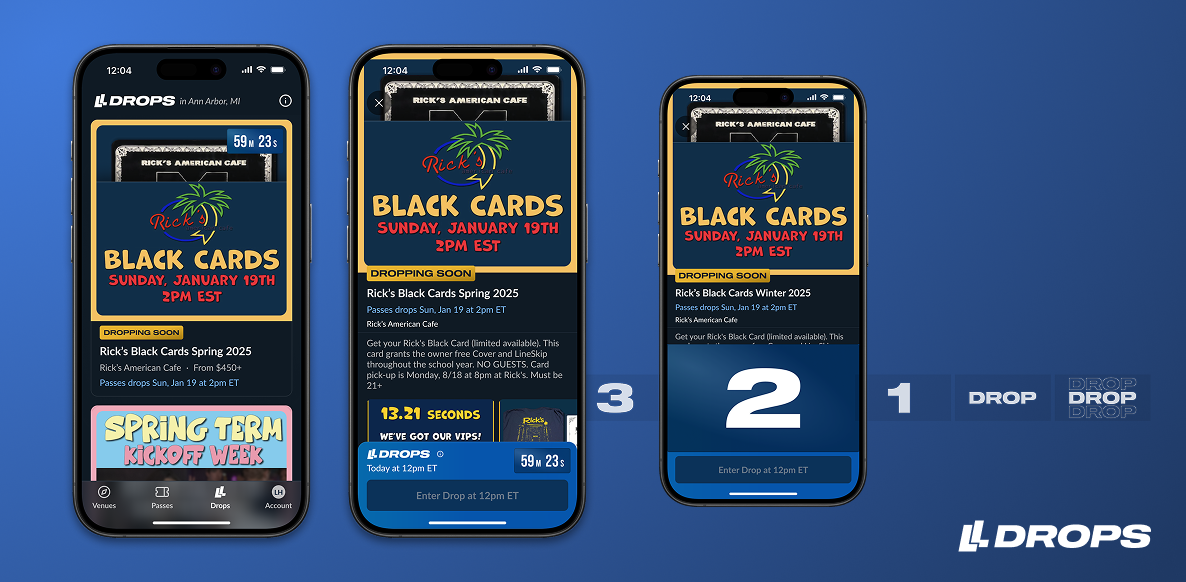
Context: Strong Core Experience, Limited Touch points
LineLeap connects nightlife venues and event organizers with college students.
- On the consumer side, users buy products like line skips, cover, and tickets through the mobile app.
- On the partner side, venues manage pricing, inventory, and reporting through the Admin Dashboard.
Our flagship product, LineSkips, made us the go-to nightlife app on weekends — but we weren’t yet part of people’s weekly routine.
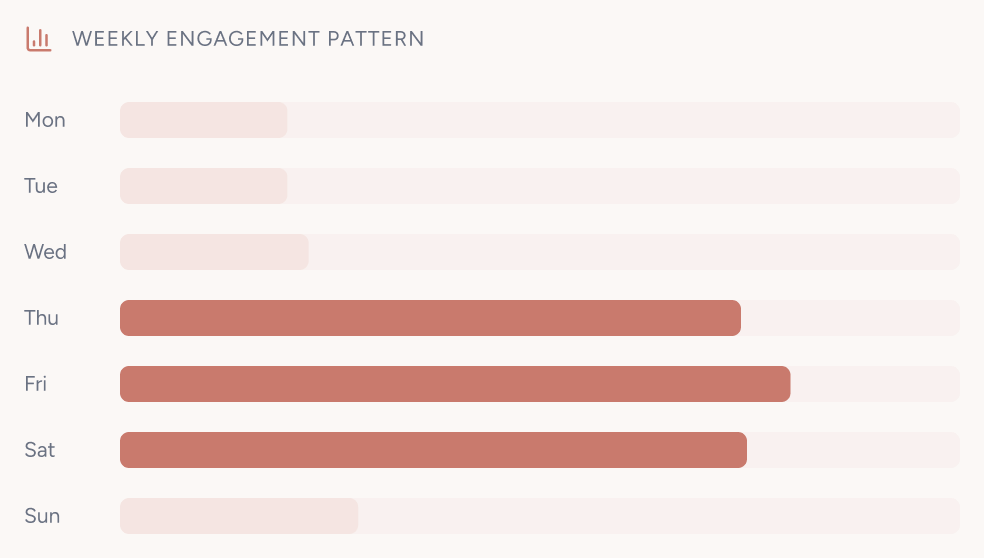
Peak engagement: Thu–Sat, 8pm–12am
Our product had a narrow interaction window, and our brand felt tied to just one use case.
Business Challenge:
How can we expand engagement beyond just the weekend?
The Challenge: Balancing Three Perspectives
We faced three competing perspectives: Our end-users, the business, and our venue partners.
- The Business needed to experiment fast
- Users’s perception of LineLeap as a purely transactional utility
- Venues were protective of their presence in-app — any layout or navigation changes risked backlash.
So the core tension became:
How do we expand engagement and experiment fast without breaking our user’s or partner’s trust?
My Approach: Leveraging Existing Discovery & Insights
My approach was to leverage what I already knew from ongoing discovery interviews and field research instead of starting from scratch.
Users: Anticipation as a Ritual
Insight: Students were already creating their own "drop" moments in real life
- “We would set our alarms at 3:55am, so we can be the first to grab these skips”
- “I’d be gathered around the table with my roommates, we’re constantly refreshing the app, whoever’s first buys for all of us”
It wasn’t just buying — it was a shared ritual, a moment of excitement we hadn’t designed for.
Venues: Building Hype as a Growth Tactic
Insight: Venues were building hype moments on social media - manually promoting limited releases
- Posting on Instagram days leading up to sale date
- Selling limited time high value products, brought high volume traffic
They were manufacturing anticipation on their own.
Both users and venues were already organically creating anticipation, but it was outside of the product. We just hadn’t built the system for it yet.
The Product Opportunity
This insight led to a clear opportunity: a new surface inside the app where anticipation could live.
Product Vision
Bring that energy into the product by creating a system that lets venues release timed offers and lets users experience the excitement in real time.
How it works:
- A drop is announced early → users see a preview
- A countdown builds hype → anticipation grows
- The drop goes live → a shared moment happens
Drops turned real behavior into a product experience — and became a new product pillar for engagement, growth, and partnership.
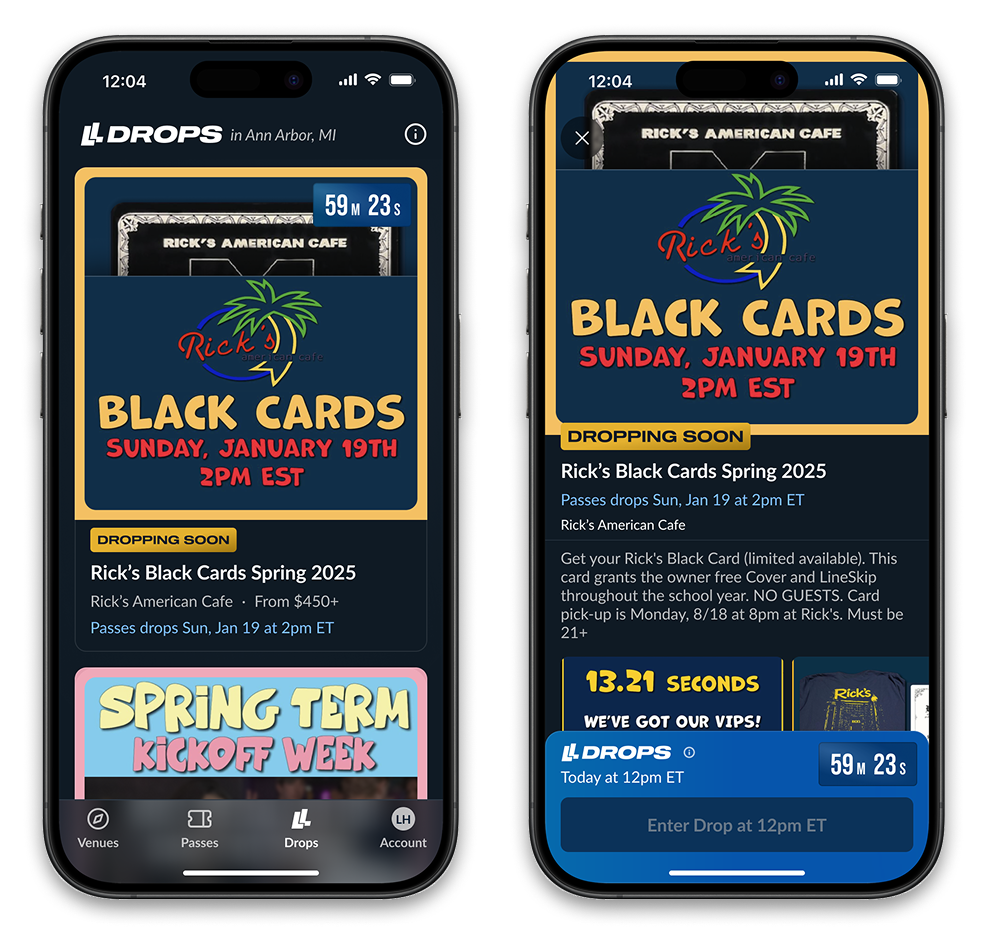
Execution: From Vision to Launch
Defining the MVP
With just five weeks to ship, I led end-to-end design — from mapping the ideal experience to defining a fast, achievable MVP.
The goal was simple: validate whether building anticipation inside the app could drive engagement and sales.
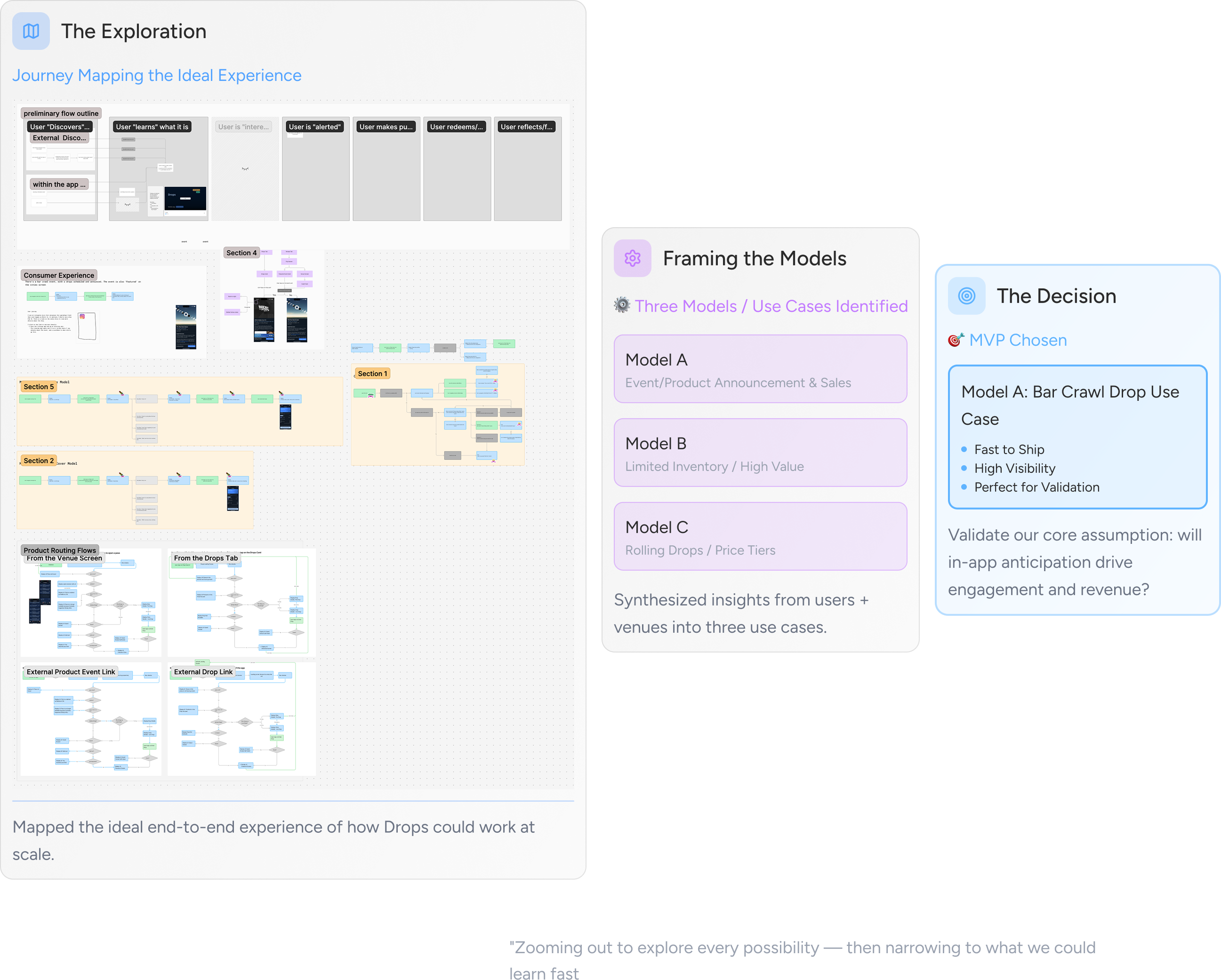
Approach: Explore → Frame → Focus
- Mapped the ideal end-to-end user & venue journey for a drop
- Identified three potential models
- Selected one test case for MVP: the St. Paddy’s Bar Crawl — a high-visibility event with clear success metrics
Collaboration & MVP Build
I collaborated with Engineering and Product to break down the MVP into user stories that represented value from a user perspective.
- This created Design <> Eng alignment and allowed for parallel execution.
- Eng can start building without having to wait for final UI designs.

That workflow enabled us to launch two weeks ahead of schedule — in time for the event promo window.
Principle: Ship fast, learn faster — optimize for real behavior, not theoretical edge cases.
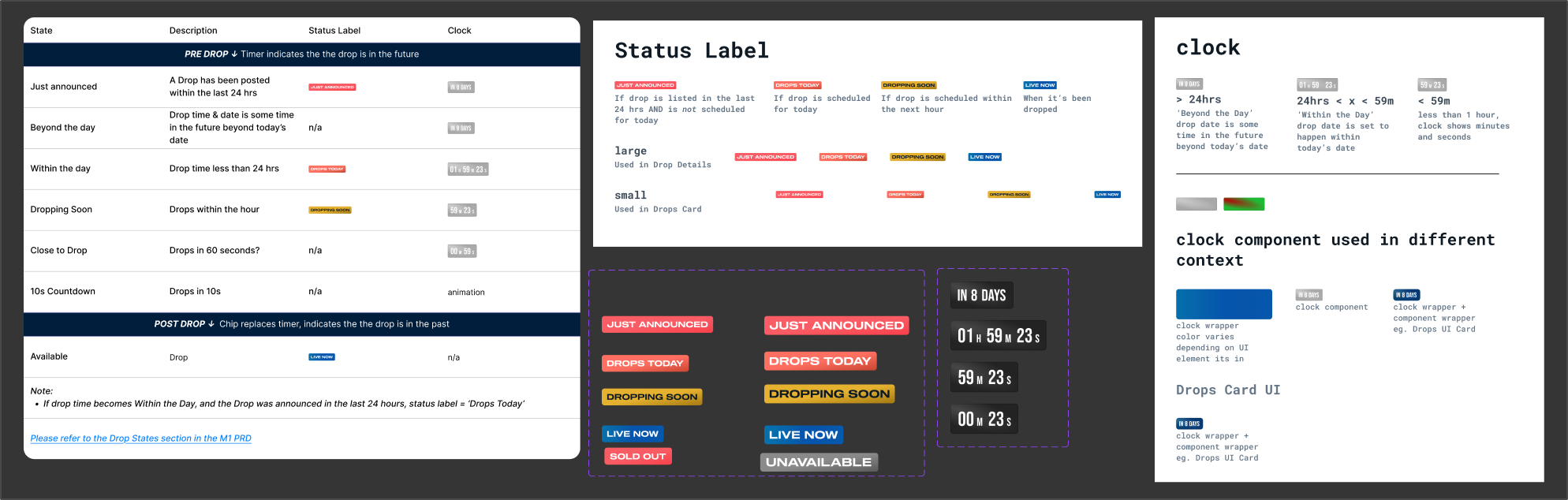
UX & UI Decisions for User Clarity and Ease of Implementation
Goal: Design decisions at this stage were made by balancing user clarity, speed of development that resulted in intentional restraint in order to launch within a few weeks.
Example Decision #1: Dedicated Drops Tab
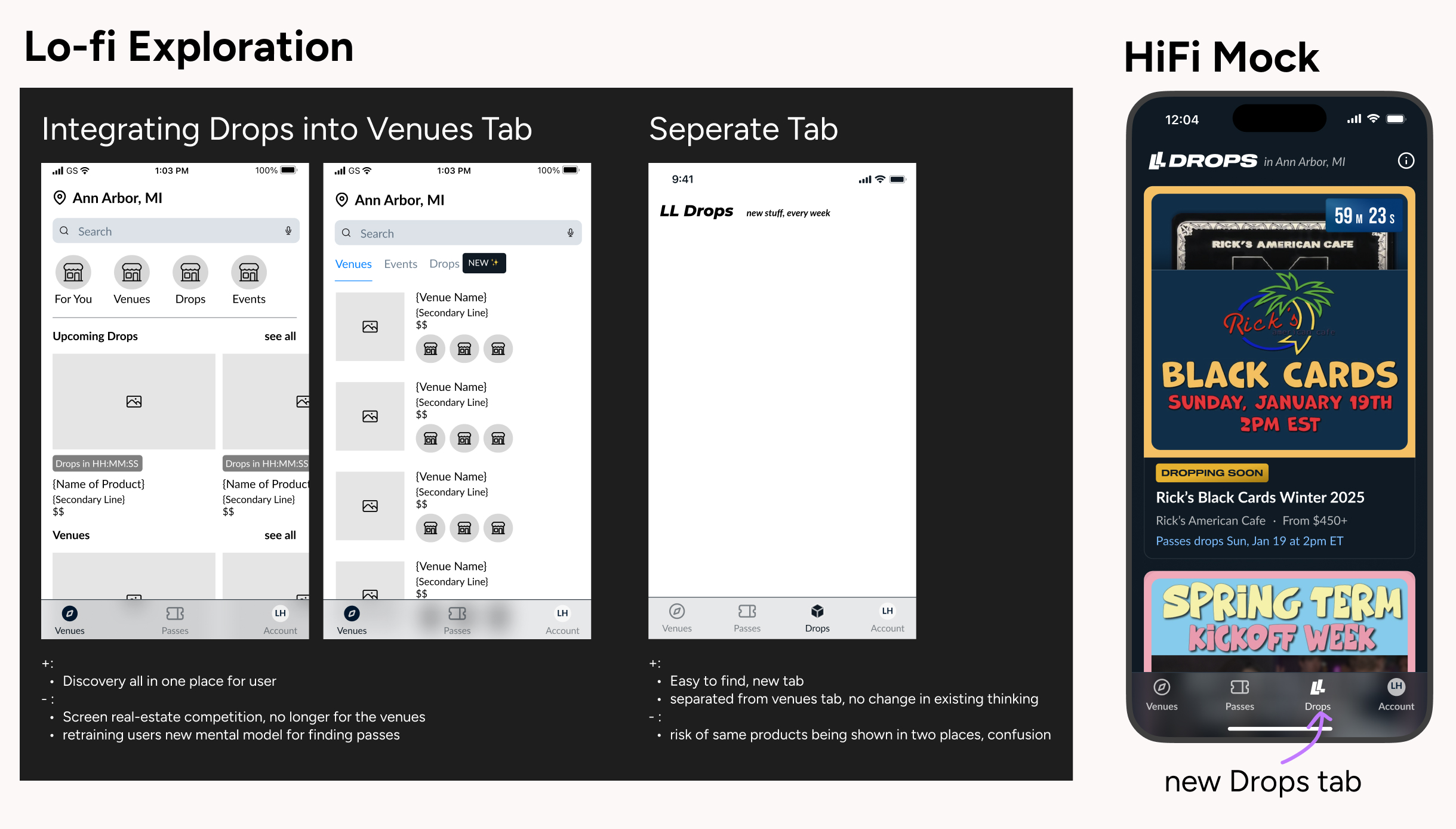
Why: Usability Clarification and Isolated Experimentation
I wanted the experience to mirror how users talked about it with friends — when they opened the app, they should instantly find what they were discussing. No guesswork. The new tab also gave the business a safe, isolated space to experiment without affecting the existing venues tab where partners list their products.
Example Decision #2: Drops Tab Layout, a Single Scroll
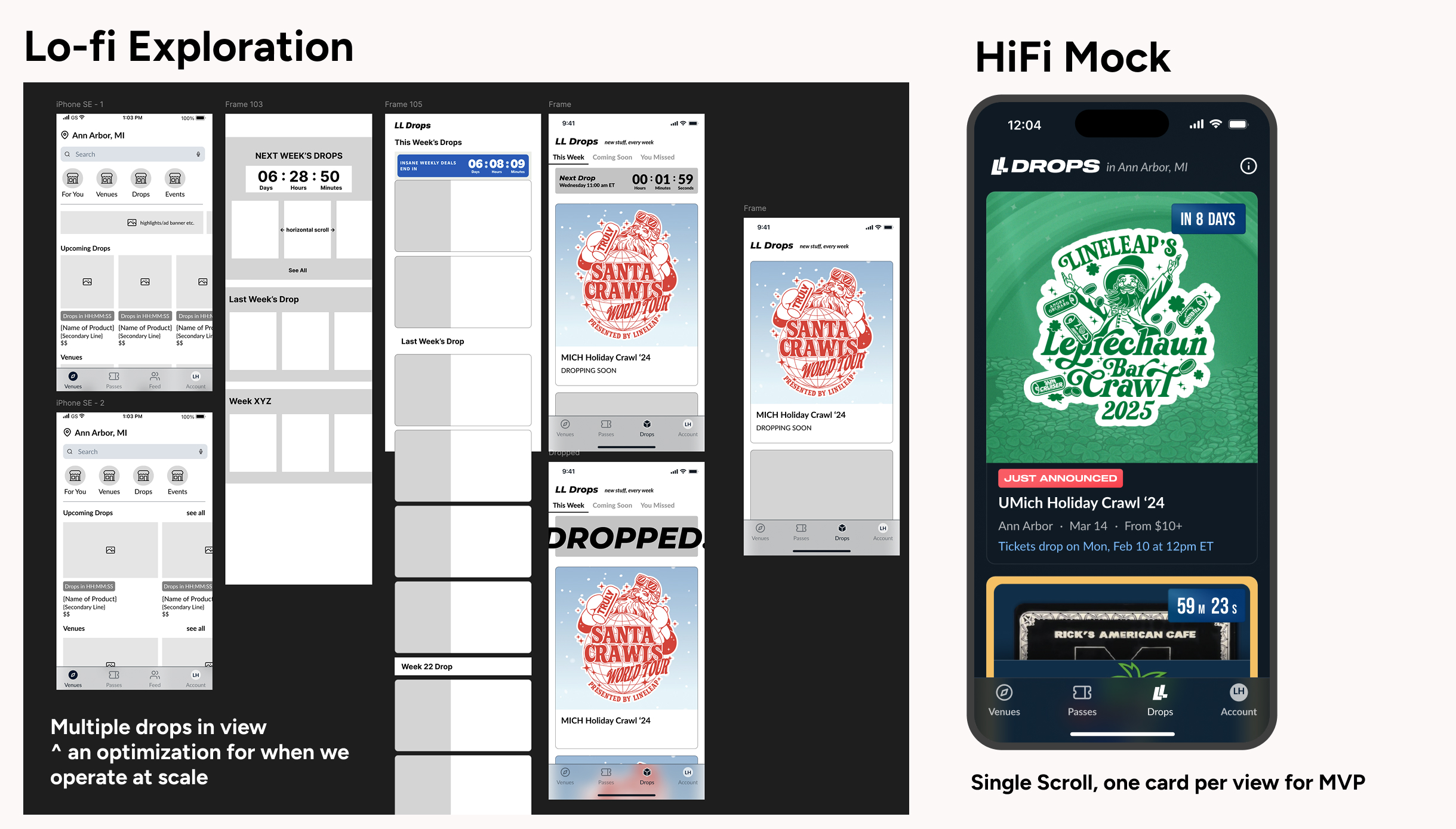
Why: Fast to Build, Easy to Learn
For the MVP, I kept the layout simple — a single, vertical scroll. Other designs were overbuilt for scale, which would have been premature at this stage. This approach reduced cognitive load and made discovery effortless.
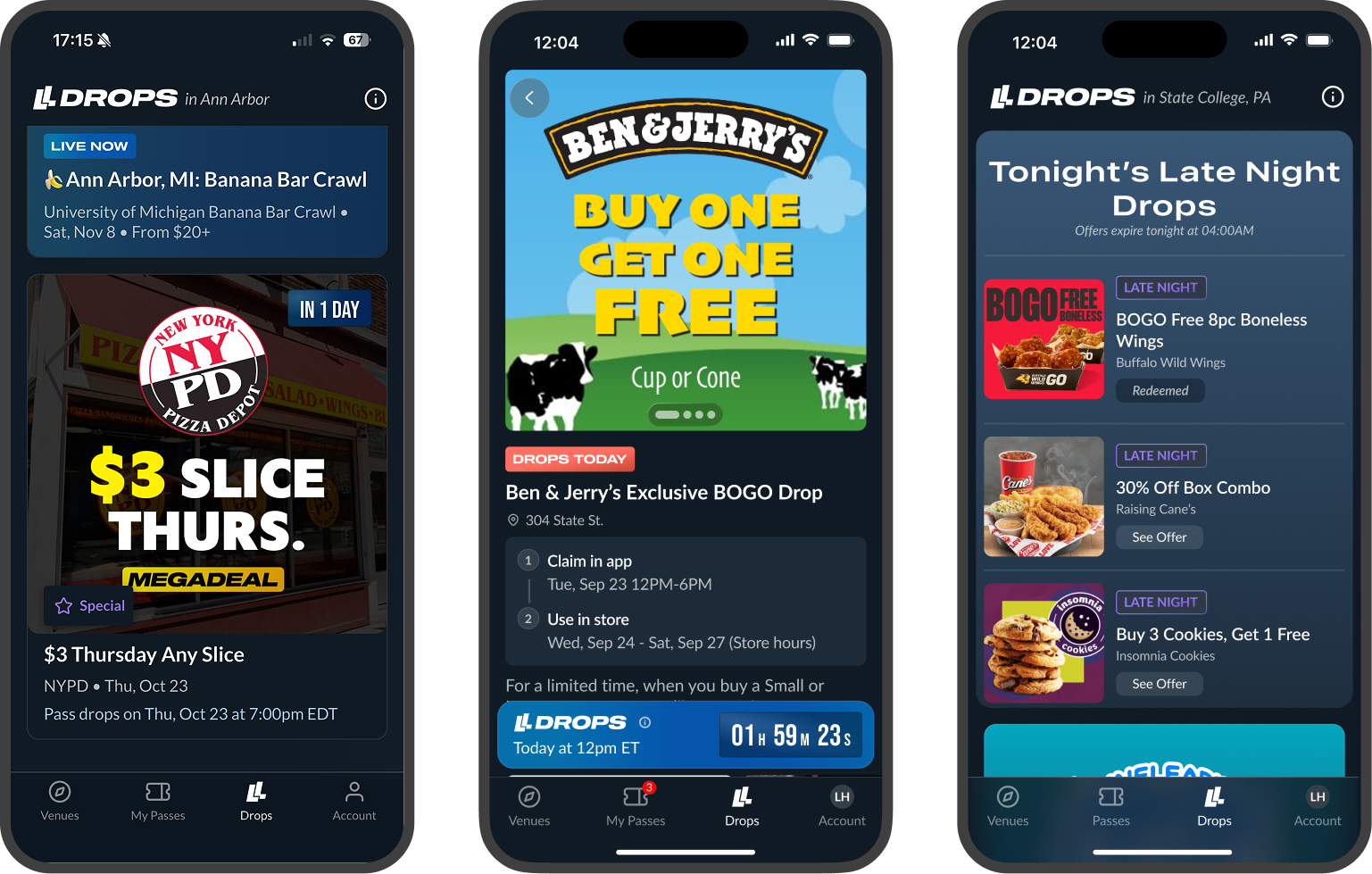
Example Decision #3: Intentional, Functional Visual Flair
Why: Exciting, but not over-whelming,
I wanted the interface to feel exciting and chaotic without overwhelming users. Every flourish needed to serve a purpose — guiding focus and reinforcing clarity. This balance kept the experience both simple and purposeful.
Impact from Launch
Working with marketing showed bar crawls were announced a month early. We split the rollout into two milestones to deliver to users sooner.
- Milestone 1 — Announcement (Released on Week 4)
- Milestone 2 — On-Sale (Released on Week 7)

Engagement on Off Days
Repeat sessions leading up to launch
Midweek visits (Sun–Wed) spiked as users checked countdown and details.
Phase 1: Announcement (Mid-February)

~2x in sales
17K → 30K year-over-year
17K

30K
+76% YoY
Phase 2: On Sale (Early March)

Venue Demand
Venues calling CX
"How do we get on Drops?"
Venues started reaching out unprompted — genuine market pull.
Organic partner interest

Social Engagement
Users sharing drops with friends
Users shared drop links, creating viral loops and bringing new users to the app.
In-app sharing activity increased
To us, that was a clear signal:Students cared. They were engaged. And we’d found something real.
Beyond the MVP: Strategic Expansion
The success of Drops went beyond the seven-week MVP. It became the foundation for a long-term product and business strategy:
- B2C Expansion: Introduced a new direct channel to communicate with end-users through live offers and event visibility.
- B2B Growth: Created new surfaces for venues, local businesses, and national brands to partner with LineLeap.
Strategic Impact: Drops evolved from a short-term experiment into a repeatable system for engagement — powering future features like Offers, Loyalty, and Sponsorships.
Outcome: What began as a feature became a strategic lever — allowing LineLeap to expand beyond nightlife transactions and grow into a full-scale engagement platform.
Final Thoughts
Drops reminded me that the most powerful ideas often come from observing what users already do — and building scalable systems around that behavior.
Designing for urgency required balancing hype with clarity, short-term validation with long-term vision.
What started as an MVP became a strategic framework that connected our users, partners, and business model in new ways.
Key Learning: When you design for human behavior — not just features — you unlock both product momentum and business growth.
Let's connect — I'd love to hear about your team.
in
@